Showing posts with label Hauts Squad. Show all posts

Thursday, 23 July 2015

Hauts : Final Hunt

FINAL HUNT


You are running out of time. You now reach the outskirts of Nepal but have no idea about the route to
Assam. You then ask a person nearby for help. He helps you but through a puzzle. He shows you 12 boxes of diff erent sizes, each having two cavities(right and left) in which smaller boxes can be kept. He then numbers each box and places one inside the other randomly without showing you.The final result is a single box. He says, he will give you the correct map only if you tell which box is in
the right cavity of box numbered ‘2’. If you fi nd out the number of that box you will get the map.

Here are your clues:
1. If he unpacks all the boxes and arrange them in a line in the following way,


then the final numbering of boxes in which the boxes are arranged would be
5    11    4    2    7    6    1    8    10    3    12    9

2. If he unpacks all the boxes and arrange them in a line in the following way,


then the fi nal numbering of boxes in which the boxes are arranged would be
1    2    4    5    11    6    7    3    8    10    9    12

Question 21:
Which box is in the right cavity of ‘2’?
(A) 11 
(B) 6 
(C) 7 
(D) 5

Question 22:
If you found out the right box then also tell how many boxes of smallest size did he show you initially?
(A) 2 
(B) 3 
(C) 4 
(D) 5


The unfolding of the map came as a complete surprise. It was not the whole map but just a part of it. The instructions below will tell you how to get the other parts.

The rest of the parts are hidden in the houses shown in the figure below. You will get the parts of the map only on delivering the right article(one per house) to all the houses.
(i) An ‘X’ coloured ARTICLE should be delivered to an ‘X’ coloured HOUSE only by using an ‘X’ coloured TRUCK.
(ii) A truck can also carry other coloured articles so that it can place them at any of the CHECKPOINTS from where other truck can later carry it to the destination.
(iii) Trucks can carry any number of articles at a time.
(iv) The main objective is to start all the trucks at the same time, with same speed and deliver the
articles without collision of trucks. Also, a truck picks up every article that comes on its way.
(v) Last and the most importantly, the PATHS of the trucks should not overlap at any point other than
junctions. At junctions, the paths can though cross each other (but both trucks should not reach that junction at same time which leads to collision). The trucks can move only forward.


Question 23:
Draw the fi nal path of all the trucks and give the number of turns taken by the blue truck.
(A) 8 
(B) 7 
(C) 6 
(D) None of the above

Question 24:
Give the total number of articles carried by the red truck on it’s way.
(A) 1 
(B) 2 
(C) 3 
(D) 4

Hauts : Tiling

TILING


You then head towards Kabul. After reaching there, you come to know that the King’s descendant found an ancient-Treasure Box. One of the men of the ancient court discovered that the code that unravels the treasure, is hidden in the below puzzles. Help the descendant and get 10% of the treasure as reward.

PUZZLE 1:
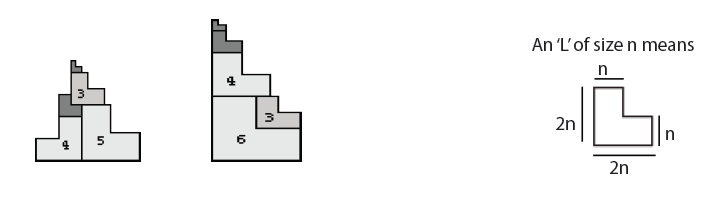
You are given ten ‘L’ shaped tiles of size 1 through 10. Stack tiles so that each tile is fully supported and also the stack is as high as possible. For example, we can stack L's of side 1 through 5 so that the stack is 18 units high and stack L’s of side 1 through 6 so that stack is 26 units high as shown in figures below.

[Note: It is not necessary that all the L’s should be present from one to 10]

Question 19:
What is the maximum height of the stack formed on stacking tiles of side 1 through 10?


And now, the shape of the stack gives you the shape of the key that unlocks the box but you still don’t know the size (in terms of number) of the key, which is hidden in the next puzzle.

PUZZLE 2:
A large square can be formed by small integer sided squares so that each square either lies on the bottom layer or lies on top of one or more larger squares. Some examples are shown below:


Question 20:
What is the smallest odd square that can be formed using above method?

Hauts : Kabuliwala's Treasure

KABULIWALA'S TREASURE


After a day fi lled with adventures in Tehran, you now reach Kandahar. You realize that you are falling short of time and should reach Kabul as early as possible but the problem is that you have lost your map and you can’t see anybody nearby. So, you don’t know where to head towards. You suddenly see a Kabuliwala, whom you ask for help. 

He says, he will show you the way to Kabul only if you help him get his treasure. Then he takes you to a place which looks similar to a grid, which has some rocks, a xed metal ball gun and
a treasure box at the other end which can be opened only when the metal ball hits the 3 buttons. Now
help the Kabuliwala arrange those blocks in order to open the treasure box.


INSTRUCTIONS:-
1. The initial direction of ball cannot be changed. The metal ball once released only travels in straight lines unless and until it hits a rock.
2. Rocks re ect the ball when it hits them.


The place where you go looks something like the above figure. For the arrangement shown in the figure, the metal ball could only hit one button. Make appropriate shifts in the positions of rocks so that the ball can hit all the three buttons.

Question 17:
What is the sum of all the positions that have rock (including fi xed) on them?
(Two digit integer type)


After the kabuliwala leaves, you find another similar grid. Solve this one to have a treasure for yourself :-

WORMHOLE ROCK :- Acts as a teleport for the ball. How it exactly works is shown in the below 2 figures.
Question 18:
What is the sum of all the positions that have rock (including wormholes) on them?
(Two digit integer type)

Hauts and Junior : Coalesce

COALESCE


As you travel from Iraq towards IIT Guwahati, after a long time you find yourselves on a mountain trail at Tehran, Iran. The mountain trail is diff cult and slippery. You suddenly get caught in a landslide and fall into a deep hole. Then the stones of 2 kg weight start falling onto you from above.
The hole is a 4x4 grid i.e., it is divided into 16 squares. Each square can accommodate only one stone (of any weight). To survive, you need at least one empty square. Owl notices your trouble and gives you the magical power to meld together stones, but only those of the same mass can be mould together. Since the stones are falling very fast, you are only able to push the stones in straight lines (horizontally/vertically).
For example, when the arrangement of one of the rows in fi gure 1 when pushed horizontally to left transforms as shown:


Question 15:
If one stone falls every second, what is the maximum time for which you can survive i.e., when no square is empty and all stones become immovable?
(A) (2^16) -1
(B) (2^17) -1
(C) (2^17) - 2
(D) 2^16

Question 16:
What is the largest stone that you can make if every second, either 2kg stone or 4 kg stones fall?
(A) 2^17
(B) 2^16
(C) (2^16) -1
(D) (2^17)-2

Hauts : Enigmathic

ENIGMATHIC


As you reach Iraq, you come across a poster mentioning a contest which could help you earn more money for your trip. So you decide to participate and below are the questions of the contest.

Question 12:
If you want to build a pile of 100 coins (1 and 2 dinars) such that, number of coins between any two ‘2’ dinar coins is not equal to five, then what are the maximum number of 2 dinar coins that can be included in the pile?

Question 13:
Minimum length of ruler required with 4 marks such that every two marks are at a diff erent distance is 6 as shown in the diagram.

Similarly, what is the minimum length of ruler required with 6 marks such that every two marks are at a diff erent distance?

Question 14:
The government of Iraq wants to issue ‘d’ denominations of coins (in whole numbers of dinars(Iraqi currency)) so that by using no more than 3 coins, citizens can pay any amount from 1 dinar to 36 dinar. Find the value of ‘d’ and all the ‘d’ denominations and give the sum of all these ‘d’ denominations?
(Ex: if d=3 and 3 denominations are {4,5,3}, answer= 4+5+3= 12.)

Hauts and Junior : Fragments

FRAGMENTS


While travelling through the Syrian Desert, you are in desperate need of water. The owl, still bursting with energy(God knows how) comes fl ying back to you to tell you that she had located a water faucet nearby. Hearing this, you rush to it, to fi nd a real water cooler. But the problem is, it has seven pieces lying on the ground which have to be fi tted to form a rectangle in order to have the faucet working.


Question 10:
Which of the following statements are correct about the rectangle formed?
(A) The corner four pieces are 1,3,5,7
(B) The corner four pieces are 1,2,5,6
(C) The corner four pieces are 2,4,5,7
(D) Rectangle cannot be formed


Suddenly, the Desert God emerges out of the faucet. He says, “I am pleased with your hard-work, and will reward you with food if you pass my challenge.” He gives you in finite number pieces of fi ve di fferent types as shown below with numbers etched on them. He then tells you to use a maximum of 30 of these pieces to make a rectangle such that the sum of the numbers on all of the small squares is maximum. Also, each type should be used at least once.


Question 11:
What is maximum sum of all the numbers that is possible?
(A) 137x4
(B) 136x4
(C) 127x4
(D) Rectangle cannot be formed

Hauts : Pyramid Walls

PYRAMID WALLS


Another break comes in your journey when you encounter a long wall in Aleppo. The wall is made of bricks of di fferent sizes and if you put all the bricks in order of their sizes, you will get a staircase and be able to cross it. So, you have to sort the bricks such that the smallest is on the top and largest at the bottom. To re-order them, you can hold any number of bricks from the top of pile, lift them, invert the pile you are holding and place the inverted pile back on the rest of the bricks below. The move has been explained in  the below diagram:


The above diagram indicates one move or step. By doing a certain number of appropriate moves, you can bring the entire pile of bricks to suit your need.


The wall stopping your way looks like the figure shown:


You have to make the staircase by sorting the wall according to the rules explained above. As you are in hurry to complete your journey, you must sort the bricks in minimum possible moves.

Question 7:
What is the minimum no. of moves required?
(A) 10
(B) 9
(C) 8
(D) 12


After crossing the wall, your journey hits another wall (see below), but this time sorted and built of hollow numbered blocks. On reaching the top of it, you see a signboard which says: “From the top block, move down one layer a time to either of the two touching blocks just below the one where you are. At the bottom, you will find a glider which fl ies for as much time as the sum of the numbers on the blocks through which you pass”. As you would want the glider to fl y for as much time as possible, you must choose the path which gives you the maximum sum.


Question 8:
Find the path and give the maximum time for which the glider can be own.
(A) 248
(B) 335
(C) 249
(D) 250


Question 9:
Can you fi nd how many paths pass through the block ‘55’ ?
(A) 48
(B) 12
(C) 24
(D) 10

Hauts : Crack The Code

CRACK THE CODE


Question 6:
You and your friend along with the owl now reach Turkey. Tired by your journey, you decide to go a bit sightseeing in the town of Istanbul. Inside the Hagia Sophia, while you all are walking, you encounter a weird looking signboard, which reads

“Lay down the letters,
Left it begins,
Right it goes,
Starting a new line”.

A trapdoor opens below you and you fall onto a gigantic chessboard. Overhead, you see a clock, which is rotating in the anticlockwise direction. Seeing this, you get puzzled.

Realizing that the only exit is an elevator across the board, you rush to it. There you nd a ghost guarding it. When asked about the exit, the ghost replies
”The board is all you have, follow lines, stay away from the edges, and watch the clock as it goes. ”

You realize that lift is not the exit and ask the Ghost what is to be done. He then gives you two words
"Powder and "Magic" and tells you to enter these words in their secret language following the clues. You decoded “Powder” as “hfvkma” . If this is the right word then what is “Magic” in their secret language?

(A) erfpk
(B) rfpkd
(C) hfvrp
(D) erfpd


Hauts and Junior: Trouble With Flowers


TROUBLE WITH FLOWERS


The tourist guide at Parthenon takes you to an abandoned tunnel. And here you fi nd an inscribed stone and a bowl of colored fl owers. Suddenly you hear a deep and ancient gong ringing as you start reading the Stone Of Instructions. The instructions read as follows:

Every person entering the Temple of Athena will be given a bowl with 15 red fl owers and 12 yellow fl owers.
Each time the Gong of Time rings, he/she must do one of two things:
1. Exchange: If he has at least 3 red flowers in his bowl, then he may exchange 3 red fl owers for 2           yellow fl owers.
2. Swap: He may replace each yellow flower in his bowl with a red fl ower and replace each red             flower in his bowl with a yellow flower. That is, if he starts with i red flowers and j yellow fl owers,     then after he performs this operation, he will have j red fl owers and i yellow flowers.

[You can leave the tunnel only when you make all the combinations (no. of red, no. of yellow) of fl owers that are possible].

Question 4:
After how many operations will you have 5 each of red and yellow flowers?
(A) 5
(B) 10
(C) 15
(D) None of the above

Question 5:
What is the number of combinations you need to make to leave the tunnel?
(A) 27
(B) 52
(C) 54
(D) None of the above

The next day, on your way back from Parthenon, you see an owl injured under a large, old tree. You decide to save the owl and x its wing, so you take it along with you. Later you get to know that owl needs to reach IIT Guwahati, India as soon as possible. Realizing how dangerous it could be for the owl to travel to India, you decide to help the owl reach its destination.

Wednesday, 22 July 2015

Hauts: Chess With A Twist

Chess With A Twist


Question 1.

Consider a chessboard of dimensions 4xN. What is the value of N among the following such that, you can start with a knight(horse) at some square of the board, proceed by valid moves, visit each square exactly once and can return to the starting point as the 4N+1st square? [Note: If the knight is at a position as shown ­figure, a valid knight move would be any square marked ‘X’] 

(A) 2
(B) 4
(C) 8 
(D) no such N exists 


Question 2.
Consider a chessboard of dimensions 4xN. What is the value of N among the following such that, you can start with a knight(horse) at some square of the board, proceed by valid moves, and can visit each square exactly once, with no requirement that we ever return to the starting square?

(A) 2
(B) 4
(C) 8 
(D) no such N exists 


Question 3.
Find out the minimum number of moves required to move from the situation in the left to that in the right if the valid moves for bishop, rook, knight, king and pawn are shown in the ­gures below respectively.


(A) 9 
(B) 18 
(C) 16 
(D) 8

So, what are you waiting for!! Go ahead & comment your solutions.

Tuesday, 6 August 2013

The One with the "Puzzle Mania"

Going In Circles 

Frogs of the Blobland, each occupying a leaf in their auspicious pond, have to arrange themselves for an holy ceremony. Full of mischief, rather than jumping directly to their correct positions, they start playing a game. They fix a frog and then the six frogs encircling it, will jump to their in-circle-neighbour’s leaf in an anticlockwise fashion (count as 1 move). Then they will choose a new frog at random, and repeat till they are arranged.The frog being chosen as the center must have exactly six neighbors encircling him.  Can you be a good instructor, and help them finish the game in least possible moves?
(How to answer? If  it takes a total of 123 moves then answer it as 0123 )


Collapsing Towers

A township, owned by Kushal resembles a 10 X 10 grid with each block containing towers, which need to be collapsed. His civil engineer, Yogesh has developed a device which when placed in any of the blocks, and triggered, collapses all the towers in the horizontal and vertical direction, but its effect cannot pass through the barriers marked in the grid. It must be ensured that it doesn’t destroy
another device, already placed in the grid.

Numbered barriers indicate the quantity of devices that could be placed in the horizontally or vertically adjacent blocks. For a crossed barrier, you can put any number of devices beside it. The devices can also be placed in a block that is not adjacent to a barrier.


Question 1:
Vinay has created 34 devices, for the plot-1.
How may these devices will not come in use?


Question 2:
To use the remaining devices, they have contracted with  another builder, Dhruv 0wning plot-2. Please help them place the devices on that grid. (Represent the position of device by shading that particular square in the particular square.)


Starry Nights

One summer night, little Vishal was lying on the roof waiting for sleep. He suddenly captures a group of 25 stars which were arranged in a 5*5 grid, which sounds weird, but that’s how it was, at least as per what he remembers.
With a close observation, he found that there were five brightness levels (1-5) of the stars and that no 2 stars of the same row or the same column had the same brightness level.
He was much more amazed to recognise 5 special constellations in the group, each containing 5 stars, one of each brightness level. Each star belongs to only one of these 5 constellation.

Next morning, he wanted to share his ‘starry’ experience with his friends; Zilani,Pavan and Manikanta, but unfortunately he could recall only a little bit of it, and he penned down  only those details , for which he was certain.
Help him complete the ‘starry’ grid.
(Put the brightness levels of stars in the grid and join boxes to make the constellations.Arrange the constellations  in the grid ,including the numbers, circles and lines. The lines joining the stars may cross each other when constellations are kept in the grid)

Hit and Trail
 

The great Indian Scientist, Roshan has been captured, and sent to jail, by the inhabitants of the planet,  Zorgo.
After acquiring all the knowledge he has, the aliens have given him a chance to save his life. He can escape by reaching the exit door, by moving either left, right, up, or down. But it’s not that simple, once he starts moving, he can be stopped only by a hit with  some barrier, or else, if he moves out of the allotted area; he is dead, Also, the slant edged barriers reflect him, on being encountered.
Whtas the minimum number of moves made by Roshan before he escapes ?
(Don’t count Hit with “End” )

Mine Boggling

A free-lance developer Manikanta got bored of the old dull Minesweeper. To give it a new twist, he has come up with this Min’E’- Boggling puzzle. The player has to find the positions where mines have been planted.The rules are simple: The numbers along a row or below a column list the sizes of the groups of adjacent mines, in that row or column. But there’s a catch, there can be any
number (>0) of safe squares between any two groups. For your help, some mines have
already been flagged.Let’s check out the beta-version of the game!

Thursday, 1 August 2013

The One With The Matematica

As promised Technothlon team is back to take the discussion further, and to more core sections. The discussion for the section, 'INGENIOSO MATEMATICA' will be on for another 2 days. There's a lot to gain from these questions. Hope to see you all commenting with your strategies, and a few shortcuts you might have discovered accidentally during the prelims.


"Juniors"


Q-1:
In the botanical garden owned by Vijay, there are three type of plants; ones which bear red flowers (I), ones which bear pink flowers (II), and rest bear both (III). Currently, the garden accommodates equal number of flowers from each category. As an effect of fertilizers, the red ones have lost their ability to reproduce and the rest two have equal chance to reproduce any of the three types, but one plant can reproduce only one plant at a time. The moment type-III plant is produced; the mother plant is treated so as to stop reproducing. If this continues for a long time, what would be the average number of child plants, that a mother plant ( type II and III) would have?

1) 1                   2) 3                  3) 2                  4) 6

Q-2:
Kanheiya has joined the summer camp, where he gets to solve some interesting problems to sharpen his brain. He has been given 2 cubes, using which he has to represent all the months and dates. Each face of a cube bears different digits (from 0-9), but the digits on the two cubes can be the same. He does that first assuming that ‘5’ will be represented as ‘5’ and not ‘05’. He then repeats the same for the case where ‘5’ is represented as ‘05’. What’s the minimum number of common faces the two cubes can have, with first cube faces adding up to give the least sum, in the two cases.

1) 2,2               2) 2,3               3) 3,3               4) 3,2

Q-3:
Megha has been selected as the Event Organizer for the upcoming Rangoli Competition in your society and has to buy 100 colour packets, using only the society fund of Rs. 100. She decides to spend all the fund for buying colours only. A red colour packet costs Rs. 6 each, a yellow one Rs. 3 and Green one for Rs 0.10. How many colour packets will she have?

(How to answer? If Megha bought 15 Red packets, 50 Yellow packets, and 35 Green packets then your answer should be: 5035 i.e. first two digits will be the number of yellow packets and the last two digits will be the number of green packets.)

Q-4:
Sanny is trying to label two wires with their capacity, which is the maximum weight it can handle. He knows that the capacity of both the wires is the same and is between 1 and 100 kg. He has 100 weights: 1kg, 2kg, 3kg, …., 100kg, to test the capacity. What is the least number of trials required by Sanny for knowing the capacity?
(How to answer? If he takes 123 trials, then answer 0123.)

Q-5:
Eight shopkeepers, who used to quarrel a lot among themselves, were given slot numbers by a fair owner as 1 to 8, such that the shopkeeper with a particular number will have his quarreling mates as his nearest numbers. The shops are separated by the roads as shown below. Now it’s the time to arrange their shops for the fair on the map such that no one will encounter his quarreling mate just next, in a row or a column or diagonally.
Sayantan, the owner has done it, can you?


(How to answer? Give the unit’s digit of all the three columns in the increasing order. Eg: if the three sums (left to right) are: 99,98,97, (which surely can’t be!) then the answer is: 0789.)


"Hauts"


Q-6:
There are 8 teams in a tournament, and are known by their captains names. Four matches will take place to select the teams for the next level. Every team plays only once. Three umpires have predicted the following winners, and see the coincidence, all three of them are correct.

Umpire-1: Sayantan, Vijay, Ashima, and Vishal.
Umpire-2: Kanheiya, Himanshu, Ashima, and Sayantan.
Umpire-3: Anirudh, Vijay, Himanshu, and Sayantan.

None picked Greeshma. Who played with Kanheiya?

1) Anirudh                  2) Vijay                       3) Vishal                     4) none of these

Q-7:
A lunar Spaceship takes off every odd hour (1,3,5,7,...), night and day, from the Piternia launching station. Every odd hour a ship, from the moon also leaves for earth. A constant distance is maintained from one another by the spaceships, in both directions , and the speed is maintained so that they arrive at the final spot on the even hour(2,4,6,8,...). You are lucky to get a chance to go in the space shuttle, with your partner. “That’s the seventh ship we’ve passed since we left the ground.”,says the person seated by the window.
On which ship are you riding?

1) E                  2) C                3) D                4) G


Q-8:
Kushal has joined the summer camp, where he gets to solve some interesting problems to sharpen his brain. He has been given 2 cubes, using which he has to represent all the months and dates. Each face of a cube bears a unique digit(from 0-9), but the digits on two cubes can be same. He does that first assuming that ‘5’ will be represented as ‘5’ and not ‘05’. He then repeats the same for the case where ‘5’ is represented as ’05’. What’s the minimum number of common faces the two cubes can have, with first cube faces adding up to give the least sum, in 2 cases.

Q-9:
A long time ago, when the Egyptian Empire was spreading across the boundaries of Egypt; several different ethnic groups were made slaves. Over time the slave communities united and made their own Pidgin(a new language) to communicate with each other. To take revenge, the oldest members of these groups: Dhruv, Sanny, and Zilani, indulged in black magic, and cursed the oldest and the most powerful Mummy of the Dynasty and its treasure: “WARTS AKA STRAW” meaning: “2013 will see the fall of Dynasty and you would be the reason”. But the curse will show its effect only when the Mummy is re-awaken, and the one who reawakens will die. To save the Empire one must get control over the Mummy.


Now in 2013 A.D., archeologists Anirudh and Vishal visit the pyramids in search of the treasure, and come across a manuscript which asks them to find the number of ways there are, to spell, “WARTS AKA STRAW” excluding the spaces, by travelling from letter to letter in the grid. Unaware of the curse, in greed
of Treasure they accidently re-awake the Mummy, and are forced to death. You can save the Empire by getting control over the Mummy if you can find this mysterious number.

(Hint: Most probably, much more than you think.)
(Hint: Every possible path passes through the center.)
(How to answer? Answer the last four digits of your answer. Eg.: if the answer is: 0123, then mark your answer as: 0123.)

Q-10:
In a botanical garden, owned by Megha; there are three types of plants, ones which bear red flowers (I), ones which bear pink flowers (II), and rest bear both (III). Currently, the garden accommodates equal number of flowers from each category. As an effect of fertilizers, the red ones have lost the ability to reproduce, and the rest two have equal chances to reproduce any of the three types, but one plant can reproduce only one plant at a time. The moment type-III plant is produced; the mother plant is treated so as to stop reproducing. If this continues for a long time, what would be the ratio of the three types of plants in the garden?

(How to answer? If the ratio is: x:y:z (say 7:8:9) then answer xyz(0789).)


Wednesday, 31 July 2013

The One Where Technothlon Unpacks

Yeah! The Technothlon team has arrived the beautiful campus of IIT Guwahati. As the team members unpacked their bags (and ideas) to start up the work for the Mains, a short delay in this discussion might have depressed you. But now we are back with the next set of solutions, and some more questions. Tomorrow we will be discussing the section, "Ingenioso Matematica".

"Work In Progress"
 

Q-1:

            The basic idea to minimize the rope being used is to place the barricades such that they are equidistant from the ends to which they would get connected. Every time a new pillar is to be placed it's placed in the mid of the 2 existing pillars.
            So, first he places the barricade in the middle of the Left and Right Pillars, using 8m rope. Then he places the next barricade in the middle of this barricade and the Left Pillar, and then between this(middle) barricade and the Right pillar, using 4+4=8m rope (The order to place these two barricades can be interchanged).
Then rest of the barricades can be placed in any order, using a total of 2+2+2+2=8m of rope.

Hence the total rope used is:
8+2*(4+2+2) = 24m rope

Q-2:
            Since he has enough funds he doesn't have to strategies things out, and he will directly arrange the barricades one by one. The rope used for the first barricade is 8m, for the second is 7m, for the third is 6m, ..... for the seventh is 2m.
Hence the total rope used is:

8+7+6+5+4+3+2=35m rope.

Q-3:
(There was a typo in the question, and the correct question should have been:
            If he applies to another such stretch, 10m long, and with 9 barricades. Then            what would be his minimum wastage? (in case of 57 m long rope))

For this correct question:
            Check for the total rope required as in case of no bar on the budget and length of rope (similar to Ques-2). Following the procedure above, it would come out to be 54m.
Hence the minimum wastage would be of 57-54 = 3m.

(Add more to your knowledge: One might interpret that minimum wastage means the worst case as in Ques-2. Be cautious!

            You must check out the length given. In this question, if the total available length had been less than 54m (say 53m) then to solve the question it would have required to find an arrangement such that it uses length less than but nearest to  53 m)

Answers:

Question-1: option-(4) 24
Question-2: option-(3) 35
Question-3: option-(1) 3


"Dcrypt D'crypto"

Ans-1: khulja sim sim
Reason: The clue for it lies in the words "wait for a second" which means we have to select the second letter from each of the words.

Since from here onwards all the questions are to be sequentially answered, i.e. the answer to a particular question will give the instruction for the next question, so the answer to all the questions must be some instruction except for the last one. (If you pay attention, you can cleverly decipher some questions directly too)


Ans-2: follow (the) arrow
Reason: Deciphered like Think outside the box, and as a hint the next question has arrow in the inscriptions.

Ans-3: next step swap even rows and read
Reason: Find the letters of "TECHNO" in the diamond. Now pick up only those letters written around these in the diamond where there is a line around the square boxes, and arrange them by following the arrow. For eg:, around T, pick up n,e,x,t in the ssense of the motion of the arrow around T, and hence 'NEXT'. Similarly for other characters.

Ans-4: divide half up half down and then alternate top & bottom
Reason: Follow the instruction fetched from the answer to the previous question. Swap the characters  in the even rows.

Ans-5: start right and alternate ends
Reason:  Distribute the 26 letters long code into 2 parts and write the second half just below the first. Now Pick first character of the upper code, second from the lower, third from the upper again, and so on.

Ans-6: reverse the abcd like a with z b with y

Reason: Pick one character from the right end and then from the left, then again from the right, and continue the same way (alternating ends).

Ans-7: ideate nurture kindle

Reason: Simply reverse a with z, b with y, and so on. (OR the hint: "Techniche speaks" can be used.)


"Code Wars"
 

Let's tabulate all the information:

(First line of the Enciphered Text comes after taking into consideration: “DASY VJBYZ YL” and “GIFT DEATH TO”)


Q-1
Start checking for every word(city) one-by-one.
Kanpur, Nagpur, Mumbai could be enciphered to “CTCIBA”. Now reject Kanpur, and Nagpur as 'C' can be deciphered only in one way. Thus, MUMBAI is the only satisfactory choice for this.

Delhi, Patna could be enciphered to “OHYFB”. Now reject Delhi as 'Y' can be deciphered only to 'T'. Patna can be deciphered keeping in consideration all the rules.

Ahmedabad, Bengaluru, Hyderabad could be enciphered to “ZKVWNBIBE”. Now reject Ahmedabad, and Bengaluru (based on similar reasons as above). Thus, HYDERABAD is the only satisfactory choice for this.

All this helps us to fill the second line of the enciphered text row.
Hence the answer is: 3+5+8=16.

Q-2
Simply check for all those characters which can't be enciphered, and add the numbers corresponding to those words(city) which contain at-least one of these characters.
Hence the answer is: 1+2+4+6+7+8=28.

Q-3
Since 'E' can be ciphered in 2 ways: V,E; and for rest of the alphabets there is only one possible option.
Moreover since 'E' comes twice in 'EUROPE' therefore it can be enciphered in total 2*1*1*1*1*2=4 ways.


Answers:

Question-1: option-(4) 16
Question-2: option-(3) 28
Question-3: option-(1) 4


Saturday, 27 July 2013

The One With All The "Decrypt"ing

Pavan in search of the ultimate mantra for success goes to a saint, living in the Himalayas. The Saint wants to test the determination Pavan has, to achieve his goal, and shows him a passage. On unlocking its door he can find the hidden code of life. But the door only opens with a magical keyword, which is hidden in the Saint’s words.
“Sky there, humbly blesses, Ajanta caves:
‘ asamba kimba amar… asamba kimba amar!!’ ”

To help him, the saint has also given him a clue:
 “Wait for a second, think carefully , repeat, you will get it.”

He also tells him,” Everything you see beyond this door, will have a relation to what you see next.”

Question 1:
Say the magical word to open the door for Pavan.

Question 2:
The door opens, and Pavan finds that a series of challenges await him. First up, is a sign board that looks like this:


Question 3:
Then he encounters  an ancient scroll, that has the following inscriptions:


Question 4:
In a dark corner, is a pillar with inscriptions all over it, here’s what it looks like:


Question 5:
An unsuccessful  hunter, has written on the walls

S L A E T N I  T H E A D D  A T T R R R A G E T N N S

(Hint: Divide and rule)

Question 6:
You are just a step away from success, echoes a voice

     ees_h_bdlk_ _ ihzadbwt_ yhi_ _twaei_caetervr

("_" represent spaces)

Question 7:
Finally, unravel the mystery of success.

   rwvzgv  mfigfiv  prmwov


(Hint : Techniche speaks)


The One "(Work) In Progress"

While supervising the construction of Metro in Technolasia, Pavan came up with quite a weird pattern of placing the barricades near the “Work in progress” board. There are 2 pillars, Left and Right, separated by 8m long stretch. He chose seven equidistant positions in this stretch to place the barricades. But the length of the rope required to connect these depends on their order of placement. Once a barricade is placed, it is connected to its immediate left and right barricades, if there is none, then to the pillar, with a stretched rope.
Assuming Pavan bought a 57m of rope.

Question 1:
What’s the minimum amount of wire he could have used?
1)28     2) 20   3) 26   4) 24

Question 2:
If he has no bar on using the fund. What’s the length of wire he could have used (not wasted)?
(not wasted)?
1) 27    2) 28   3) 35    4) 36

Question 3:
If he applies to another such stretch, 9m long, and with 9 barricades. Then what
would be his minimum wastage? (in case of 57 m long rope)
1) 3      2) 2      3) 0     4) 1


The One Where Technothlon Answers

"The Drowning City"


Let’s start with filling up the grid. Let for our purpose, the cell in Row-x and Column-y be denoted as: (x, y).

·     Try to fill column E. To satisfy 12 at the top we must not fill (1,E) with 9,8,7,6 (Rule-5), and also not with 2,3,4,5,6,7 (Rule-3). So it has to be 1. So should be (4,E), (3,B), and (6,B). Now to satisfy 12 at the top of col-E, (3,E), (6,F), (1,B), and (4,B) must be 8.
·    Since we start at the top of column F, people from (2,E) will be rescued before we reach the right of Row-2. Hence, (2,F), (2,C), (5,F), (5,C) are 5.
·     Let’s see (3,F), it can’t be filled with 1(check (2,C)),3,4,5,6,7,8, or, 9 (Rule-3) therefore it has to be 2; so should be (6,F), (1,C), (4,C).
·    Similarly, (2,D) can’t be filled with 1,2,3,4,5,6,7,8 (Rule-3), and it’s 9 along with (2,A), (5,A), and (5,D).
·     Only possible choice for (3,C) and hence (3,D), (3,A), (6,A) and (6,D) is 4.

The numbers outside the grid can be filled now.
(Remember: You can’t save one’s who have already been saved. Be cautious while answering the questions. Avoid over-counting.)

·   Brown and Green box represents the ones who couldn’t be saved in the original situation.
·    Green box represents the ones who could have been saved if the diagonal light was allowed.

Question-1: option-1) 4
Question-2: option-3) 25
Question-3: option-1) 9


"Jumbled"

(A few clarifications:
  • In Q2, ‘None of these’ means ‘None of these’ and nothing else, unlike what is being interpreted in the discussion.
  • In Q4 we asked for option which is where the attentiveness is being tested as Q-2 doesn’t contain 3 and 4 and Q-4 doesn’t contain 0 in any of the options.)


Let’s start by rejecting the inappropriate options.
  • In Q1, reject opt-3 (Rule-2).
  • In Q2, reject opt-4 (Rule-1).
  • In Q3, reject opt-4 (Rule-2).
  • In Q4, reject opt-1 (read Q4).

Interestingly, you can solve the Q2 before any other Ques, but when all Ques are taken in account, you must chose opt-2 for Q3 else it will create a contradiction. And this is where the actual thinking was involved, and the approach, “Start your thinking process from Q3, and hence it’s ans is opt-2” is not strong enough to support the answer to Q3.

Based on the above step, reject opt-4 in Q1.In Q2, reject opt-2 i.e. 0 as then ans to Q4 would be opt-3, a contradiction. Also reject opt-1 as that would mean ans to Q4 is opt-4 and the 2 ques to have opt-3 as their ans must be Q1 & Q3-a contradiction to above answers.
=>Ans to Q2 is opt-3. => Ans to Q-4 is opt-2.
Now Q1 is left to be answered at the end. => Ans to Q1 is opt-1.

Question-1: option-1) 1
Question-2: option-3) 1
Question-3: option-2) 3
Question-4: option-2) 3


"Follow The Arrow"


(will be updated with the next set of Solutions. The discussion is still on.)